The Bayuda Desert
On this page
Black volcanic cones inside the great bend of the Nile, and a sky with nothing in the way.
The archive documents heritage; it does not confirm that travel is safe. Read current travel advice before planning a journey. Travel advice
- Location
- Inside the Nile's great bend, north of Khartoum
- Terrain
- Volcanic field, basalt cones, wadis
- People
- Bisharin and Kababish herders
- Best nights
- New moon, November to February
Inside the bend
North of Khartoum the Nile does something strange: it turns and flows south-west for hundreds of kilometres before resuming its journey north. The land enclosed by that great bend is the Bayuda — a desert of black gravel plains, dry wadis and, at its heart, a field of volcanic cones and craters that is one of the more unusual landscapes in the Sahara.
The short way across
Because the river takes such a long detour, the desert crossing is the short way. Caravans have cut directly across the Bayuda between Khartoum and the northern Nile for as long as there has been trade on this river, and the wells along the route determined where everyone stopped. The Meheila road still follows that logic today.
Herders' country
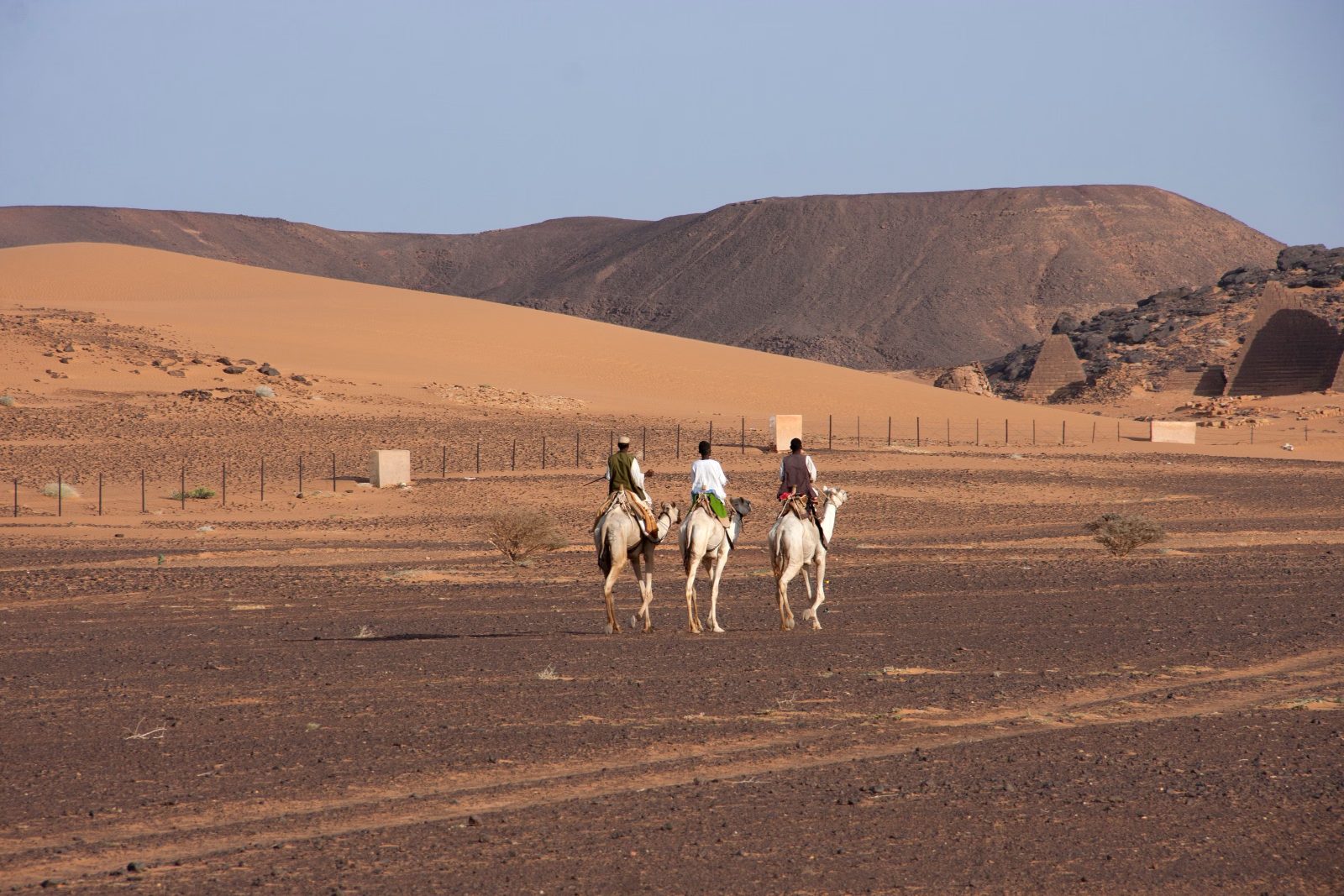
The Bayuda is not empty. Bisharin and Kababish herders move camels and goats between wells and seasonal grazing across it, and a camp encountered at dusk is likely to end in tea. Water is the organising fact of life here, and knowledge of the wells is inherited.
The sky
There is effectively no light pollution in the Bayuda and very little humidity. On a clear moonless night the Milky Way is bright enough to be uncomfortable to look at directly, and bright enough to cast a faint shadow on pale sand. This, more than the volcanoes, is what people come back for.
Going there
Bayuda is a four-wheel-drive journey with a guide who knows the wells — not a self-drive destination. Most visitors combine it with Meroë to the east or Karima and Jebel Barkal to the north, camping one or two nights in the volcanic field.