Khartoum
On this page
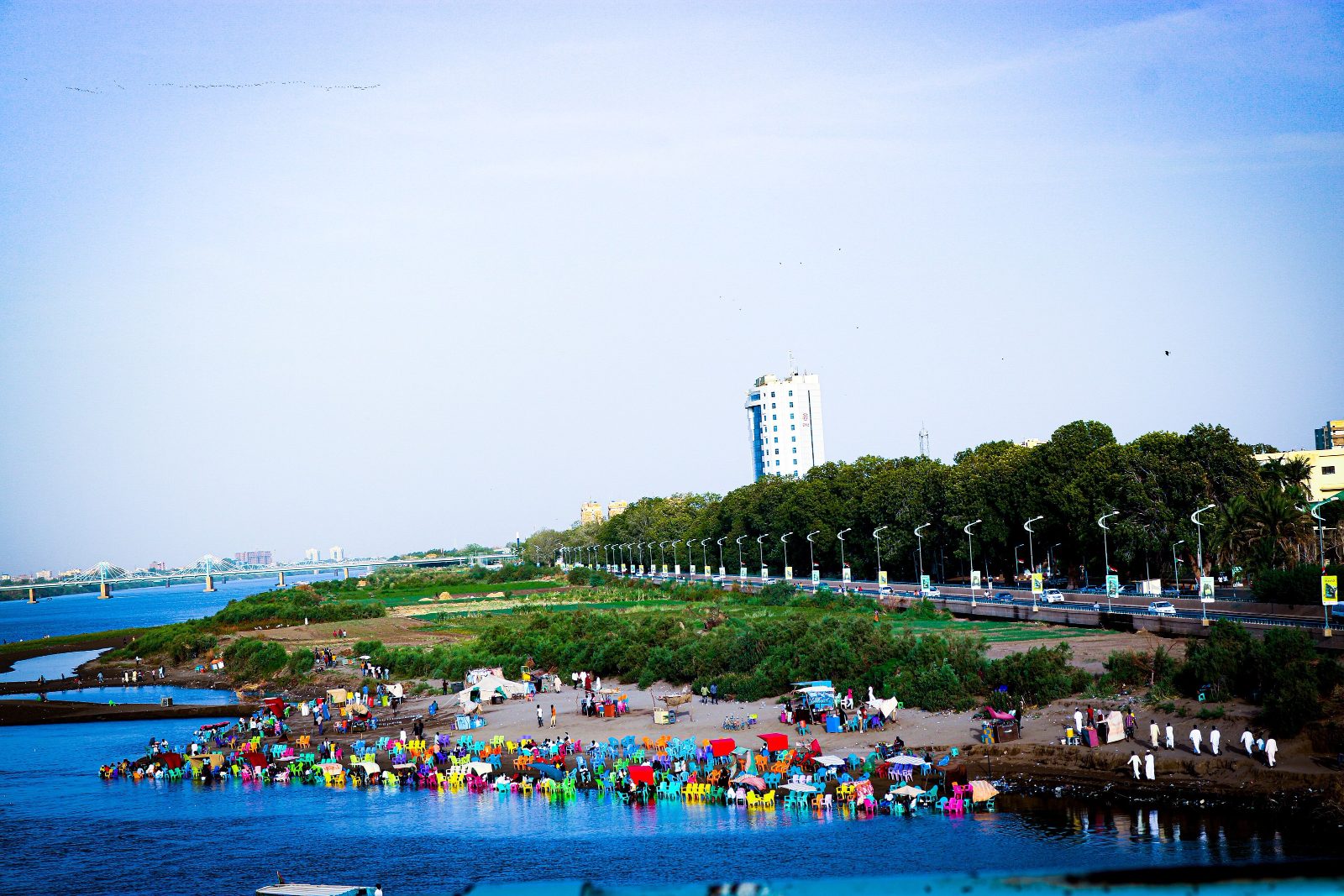
Where the Blue and White Nile meet and run side by side, visibly unmixed, before becoming one river.
The archive documents heritage; it does not confirm that travel is safe. Read current travel advice before planning a journey. Travel advice
- The confluence
- Al-Mogran — 'the meeting'
- Three cities
- Khartoum, Khartoum North, Omdurman
- Founded
- 1821, as a military camp
- Don't miss
- Friday dervishes at Hamed el-Nil
Two rivers, one city
The Blue Nile arrives from the Ethiopian highlands carrying silt; the White Nile arrives from the equatorial lakes carrying almost none. At al-Mogran they meet and, because the two waters differ in sediment load and temperature, they run side by side in a single bed for a visible distance before mixing. From Tuti Island, in the fork between them, the seam is clear to the naked eye — most sharply in the flood season when the Blue Nile is heaviest.
A capital of three
Khartoum is really three cities around one confluence: Khartoum proper, laid out from 1821; Khartoum North, the industrial and rail town; and Omdurman across the water, which the Mahdist state made its capital in 1885 and which remains the cultural heart — the largest souk, the wrestling grounds, the music.
The National Museum
The National Museum of Sudan holds the great Nubian collections, and in its garden stand entire temples moved stone by stone from Buhen, Semna and Kumma before the reservoir of the Aswan High Dam rose over them in the 1960s. It is one of the most important collections of Nubian material anywhere.
Friday at Hamed el-Nil
On Friday afternoons, at the tomb of the nineteenth-century Sufi sheikh Hamed el-Nil in Omdurman, dervishes of the Qadiriyya order gather in green and red robes and turn to the drums until sunset. It is a devotional gathering, not a performance — visitors are welcome, and are expected to behave as guests.
Tuti Island
In the middle of the confluence sits Tuti, a farming island reached by footbridge, where market gardens still grow between the two Niles a few minutes from the centre of a capital city.