Visit Sudan — the national logo: زُر السودان above the wordmark, with the living emblem

Sonne, Stein und Fluss.

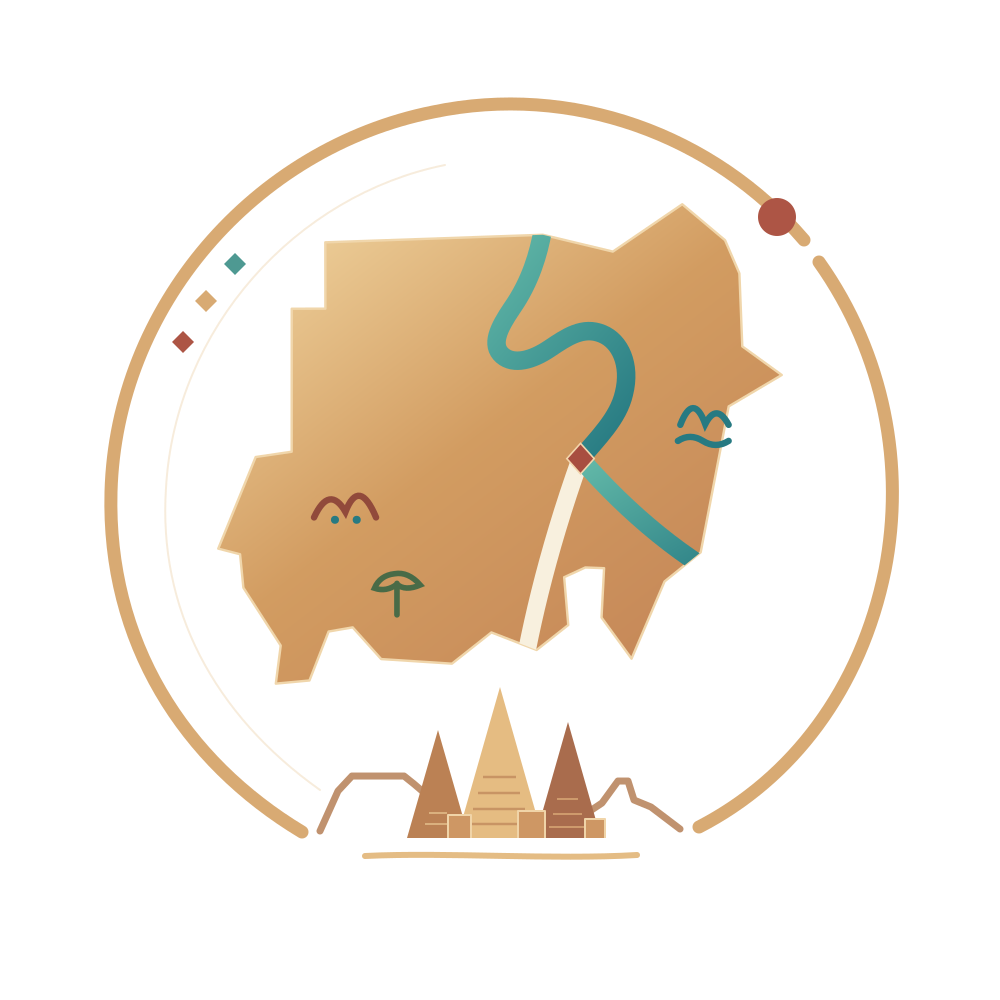
Ein goldenes Siegel hält Sudans drei Gewissheiten — die steilen Pyramiden von Kusch, den Nil, der sie ermöglichte, und die Wüstensonne, die den Stein im Morgengrauen entzündet.

Die Sonne — die Morgendämmerung über der Wüste, wenn die Nekropole von Meroë entbrennt.
Die Pyramide — die Königspyramide von Kusch, von denen Sudan über zweihundert besitzt.
Der Nil — die Pyramide, gespiegelt im Fluss, der jedes Reich ermöglichte. Auf Bildschirmen schimmert das Spiegelbild.
Das offene Siegel — der Ring, wie eine Münze geprägt, bleibt an seiner Basis bewusst offen.

Warum dieses Zeichen

Das ganze Land, in einem Siegel.

Das Königreich Kusch bestattete seine Herrscher unter steilen, schmalen Pyramiden — und baute mehr davon als jede Zivilisation der Welt. Über zweihundert stehen noch in Meroë, die meisten allein, die meisten unbesucht. Das Zeichen stellt die Silhouette, die jeder Sudanese kennt, an den Horizont, wo die Wüste seit jeher das Wasser trifft.

Unter dem Horizont kehrt die Pyramide wieder, gespiegelt im Nil — dem Fluss, der jedes Reich von Kerma bis Khartum nährte. Über der Spitze die Sonne der Ostwüste. Um alle drei ein Siegel, geprägt wie eine antike Münze, doch am Fuß offen gelassen. Das Zeichen musste nicht erfunden werden: Sudan hatte es vor viertausend Jahren gebaut.
Palette des Landes

Farben, die schon hier waren.

Nichts in dieser Palette wurde nach Geschmack gewählt. Jede Farbe stammt von etwas, das im Sudan gebaut, gefärbt, gebrannt oder gewachsen ist.

#D4AF37

Meroitic gold

The name itself

The word Nubia traces back to the ancient Egyptian nbu — gold. This was never a peripheral region but the trade corridor that carried gold north. It is the primary colour of the system, and the only one the mark is drawn in.

#9E4733

Nubian sandstone

The stone the tombs were cut from

The red sandstone of the Meroitic pyramids and the fired brick of Khartoum's 1950s facades. Used for links, underlines and anything that asks to be followed.

#1B4D8F

Facade cobalt

Sky and the Nile at once

Walk into an old Nubian village and the first thing you notice is colour: whitewashed walls edged in cobalt and ochre. In that tradition blue carries both the sky and the river — the same blue that outlines every painted doorway on the Nile.

#C67A2E

Sand ochre

Desert sand

The second edging colour of the painted facades, and the plain meaning of yellow in the Nubian scheme: sand. It sits between the gold and the sandstone and warms everything it touches.

#F5EFEB

Lime whitewash

Shade, made

Homes were coated in white and yellow lime to reflect the sun and keep the heat out of the walls. It is the ground of this entire archive — the page itself is a whitewashed wall.

#6B8E23 · #1A7A9B

Marra green & Red Sea teal

Growth · water

Green means nature in the Nubian colour scheme, and here it means the volcanic terraces of Jebel Marra. The teal is the reef water of Sanganeb. Both are regional accents only — they mark where you are, never the brand.

Sources: illustrarch, Nubian Architecture: Color, Climate, and Community Along the Nile — whitewashed walls edged in cobalt and ochre; the etymology of Nubia from nbu, gold · BabMasr, Nubian Houses — lime coatings, and yellow for sand, green for nature, blue for sky and Nile · ArchDaily, Motifs and Ornamentations — geometric symbols as household protection.

Die gemalte Geometrie

Viertausend Jahre, ein Muster.

Bei Ausgrabungen in Kerma fanden Archäologen geometrische Muster auf viertausend Jahre alten Hauswänden — und erkannten sie sofort: Es sind dieselben, die nubische Familien heute noch malen.

The running chevron

The zigzag that runs the length of a painted doorway — read across Sudan as the continuity of life, water and lineage without a break. It divides the chapters of this archive.

The diamond lattice

The protective lozenge, painted beside the eye and the hand of Fatima on Nubian facades. Nubians hold that these marks guard against harm, using colour to make an envelope of protection.

The tabag coil

The radial stitch of a Darfuri food cover — palm leaf wrapped tight round a papyrus core. Women wove symbolic patterns into the tabag to speak to the Sultan without words; certain shapes are read across Sudan.

Putz
#FCFAF7
Nilblau
#1F6FA8
Ocker
#D9A22B
Fassadenrot
#B5382A
Linienschwarz
#1A1A1A
The pigment set is documented, not invented: Nubian women plaster the wall in white or light clay, then paint geometric patterns, floral motifs and symbolic designs in bold blue, yellow, red and black. Blue and white are favoured for their association with the colour of the Nile and the sky. Sources: ArtOfNubia on the Kerma excavations and the living patterns · Nubian Wall Paintings and Architecture · AramcoWorld, "The Decorated Houses of Nubia" · ArchDaily on protective symbols · SSLH Museum on the tabag as an unwritten language.

Verwendung

Drei Höflichkeiten.

Gib ihm Luft

Freiraum um das Siegel im Durchmesser der Sonne, auf jeder Seite.

Gib ihm Luft

Freiraum um das Siegel in Breite des Halos, auf jeder Seite.

Gold ist die einzige Farbe

Ein Metall, von Rand zu Rand. Füge dem Zeichen nie eine zweite Farbe hinzu.

Schließe den Ring nie

Das Siegel ist an seiner Basis bewusst offen. Lass die Lücke.