- Site
- Old Dongola (Tungul), Northern State
- Kingdom
- Makuria
- Size (2026 estimate)
- about 47 × 57 m
- Height
- at least 21 m (estimate)
- Walls still standing
- up to about 11 m
- Identified
- 2021
- Original floor reached
- winter season 2025–26
- Excavators
- PCMA UW with NCAM
- Director
- Prof. Artur Obłuski
- GPS
- 18.22, 30.75
What was found in 2026
During last winter’s field season, a joint expedition of the Polish Centre of Mediterranean Archaeology at the University of Warsaw (PCMA UW) and Sudan’s National Corporation for Antiquities and Museums (NCAM) uncovered a monumental staircase leading into the Great Church of Jesus, massive buttresses supporting its apse and, for the first time, part of the building’s original floor.[2][3]
So far the floor has been reached only at the bottom of that one staircase. The walls around the stairwell still stand about 11 metres high, so the team has to dig through far deeper deposits than on a normal excavation.[3][5]
Only a small part of the church has been opened. The expedition is directed by Prof. Artur Obłuski, and the results were made public in November 2026.[2][3]
How big was the Great Church of Jesus?
The team now estimates that the church was about 47 metres wide and 57 metres long (154 by 187 feet), with a cautious height estimate of 21 metres, taller than a six-storey building. Obłuski has said it was bigger than the White House in Washington, D.C.[2][3][4]
The estimate has grown as the digging continued. The university’s 2021 report gave a width of about 26 metres and an apse about 6 metres across.[5]
Arab historical sources describe it as the richest church in medieval Nubia, and archaeologists believe it was also the largest.[2]
A second church, upstairs
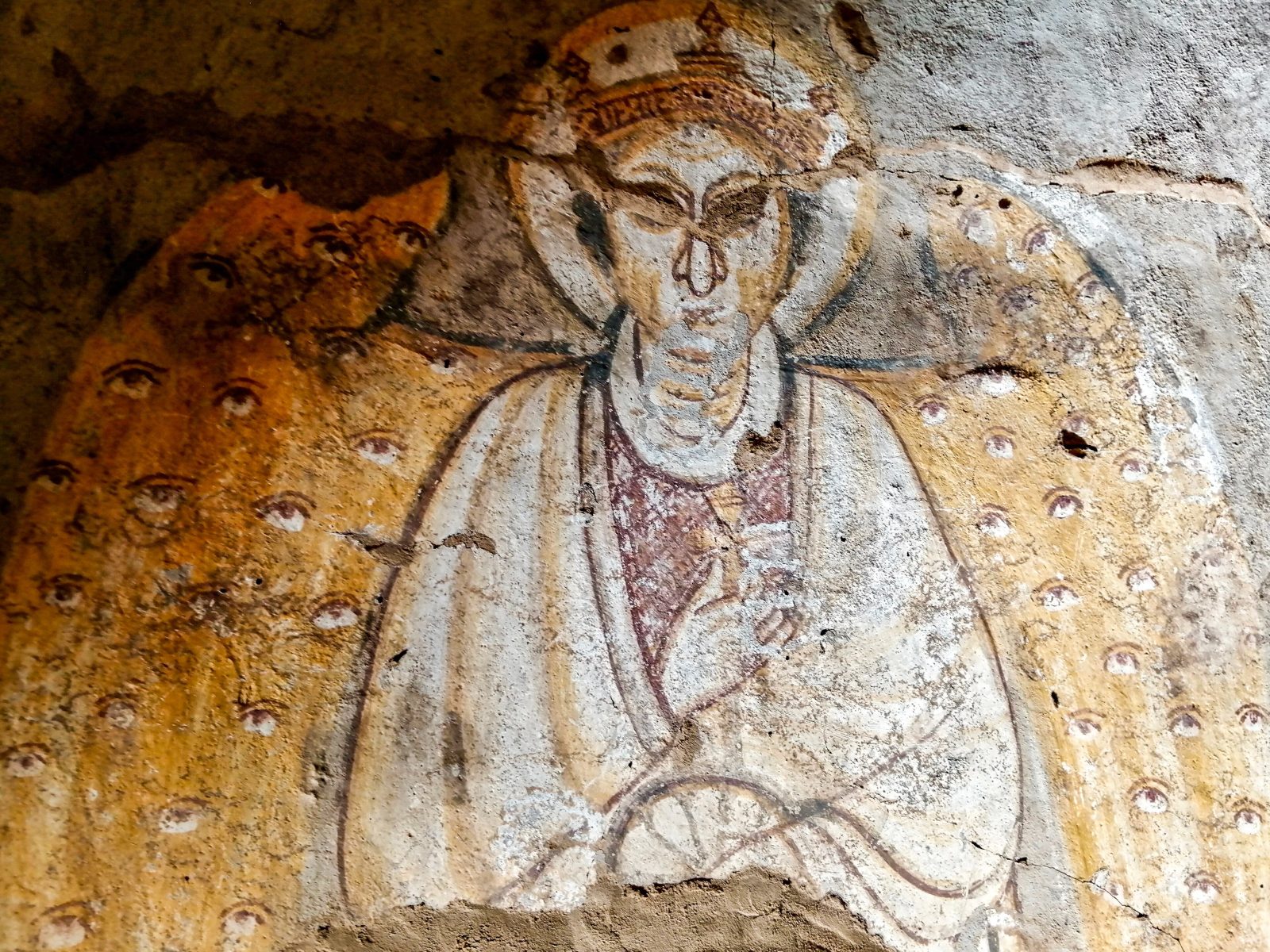
In a structure added to the side of the Great Church, the team found another church built on the first floor. Its walls survive only about a metre high, but its interior had been covered in paintings. Most of the plaster fell long ago; the fragments now fill six large bookcases. “We know they were magnificent paintings,” Obłuski said.[2]
There is a parallel on the other side of the Great Church. In 2023 the same team found, on its north side, a church associated with King David of Makuria, who reigned in the 13th century, whose walls kept far more of their paint. The room with King David’s portrait resembles a crypt, but it sits 7 metres above the medieval ground level.[2][3][6]
The Prayer of Hannah: Greek texts on the walls
Among the painted plaster were inscriptions in Greek. The expedition’s epigraphist, Dr Agata Deptuła, identified them as fragments of biblical odes, prayer songs that accompanied the Book of Psalms. One fragment preserves part of the Prayer of Hannah, the mother of the prophet Samuel.[2]
The scribe wrote in a careful book hand, with letters only about half a centimetre tall. Psalms were already the most common biblical texts found at Old Dongola; the odes are new to the site’s written record.[2][3]
Theories and points of view
Was this the real cathedral of Dongola?
For decades scholars treated a church outside the city walls as Dongola’s cathedral. The Great Church of Jesus is now the stronger candidate for the seat of the Bishop of Dongola, one of the most senior Christian figures in medieval Africa south of the Sahara. If so, the role of the church outside the walls has to be rethought.[3][4]
A trendsetter for Nubia
Obłuski compares the building to Hagia Sophia in Constantinople, a church whose design shaped later architecture. He calls the Great Church “a natural candidate” for that role in Nubia, “and perhaps even for this part of Africa.”[2][5]
Did the church push a king to war?
Arab sources say King David’s attack on Egypt, in which he captured the port of Aidhab and Aswan, was instigated by the Great Church of Jesus. After the 2023 find the archaeologists asked whether the Archbishop of Dongola, “much like Pope Urban II”, had urged the king to a crusade.[6]
What we don’t know yet
The university’s 2026 statement is a news report, not a peer-reviewed paper. It gives no construction date for the church and names no ode other than Hannah’s prayer.[5]
The other 2026 discovery: a “legendary” king was real
In March 2026 three PCMA researchers, Tomasz Barański, Artur Obłuski and Maciej Wyżgoł, published a short Arabic order issued in the name of King Qashqash. Until then he was known only from brief mentions in later writings, including Sudanese biographical traditions that name him as an ancestor of prominent religious figures.[8][9]
The order tells a subordinate named Khidr to receive three units of cloth from a man named Muhammad al-ʿArab and to give him a ewe and her lamb, collected from ʿAbd al-Jabir. The researchers read it as a reciprocal gift exchange that bound local elites and visiting merchants to the king, rather than simple trade.[9]
It was found in a large residence in the citadel known locally as the “King’s House”, together with more than twenty Arabic documents, silk, cotton and linen textiles, leather footwear, a dagger handle of ivory or rhinoceros horn, musket balls and a powder horn. Coins in the same room were minted under the Ottoman sultan Murad IV (1623–1640). Qashqash probably ruled in the late 16th or early 17th century.[9]
The sheet is small and irregular, and its Arabic has grammatical irregularities: it may be a draft, written when Arabic was still taking root as an administrative language. The king’s scribes were writing Arabic by the turn of the 17th century, though Nubian almost certainly remained the language of daily life. Qashqash’s descendants still live in the Dongola region.[9][10]
The people behind the excavation
Polish archaeologists have worked at Dongola since 1964, continuing research begun by Prof. Kazimierz Michałowski. The current work belongs to the European Research Council project Afropolis Tungul, which traces the city’s growth from the 4th to the 15th century.[3][7]
Digging through flood and war
In autumn 2024 the worst flooding since 1988 hit Old Dongola and damaged protective roofs over the ruins, so conservation with the Warsaw University of Technology came first. The team also finished a solar installation, funded by Polish Aid, that pumps Nile water to the homes and fields of about 10,000 people; eight booster stations now reach higher ground where residents had lost water because of the conflict.[3]
The team runs heritage-protection workshops for residents and shared an iftar meal with them during Ramadan. Sudan’s antiquities authority supports excavating the whole church, which could draw visitors to the region.[3]
Old Dongola: before and after
- c. 4th century ADThe Kingdom of Kush, centred at Meroë, comes to an end.[13]
- 5th centuryDongola is founded as a fortress.[11]
- 6th centuryMakuria converts to Christianity.[4]
- Late 7th centuryThe Church of the Granite Columns, with 16 granite columns, is built over the Old Church.[11]
- 13th centuryKing David reigns. A church with his portrait stands north of the Great Church; Arab sources link his attack on Aidhab and Aswan to the Great Church.[2][6]
- 1317An inscription records an expedition sent by the Sultan of Egypt to place his nominee Abdullah on the throne.[11]
- Mid-14th centuryOld Dongola ceases to be Makuria’s capital and becomes the capital of a smaller kingdom.[12]
- 16th centuryThat kingdom is absorbed by the Funj Sultanate, which rules the region until the late 18th century.[12]
- Late 16th – early 17th c.King Qashqash rules from Dongola; his scribes write in Arabic.[9][10]
- 17th centuryA house compound is built on top of a Makurian church.[16]
- 1812Mamluks fleeing Egypt conquer Old Dongola and found the city of New Dongola.[11]
- 1820The Turco-Egyptian invasion begins the colonial era in Sudan.[9]
- 2021The Great Church of Jesus is identified.[2]
- 2023The King David painting is found on the church’s north side.[2][6]
- 2024The worst flood since 1988 damages the site.[3]
- 2025–26The original floor is reached and a second painted church is found.[3]
- Nov 2026The discovery is announced.[2]
What Sudan looked like when the church stood
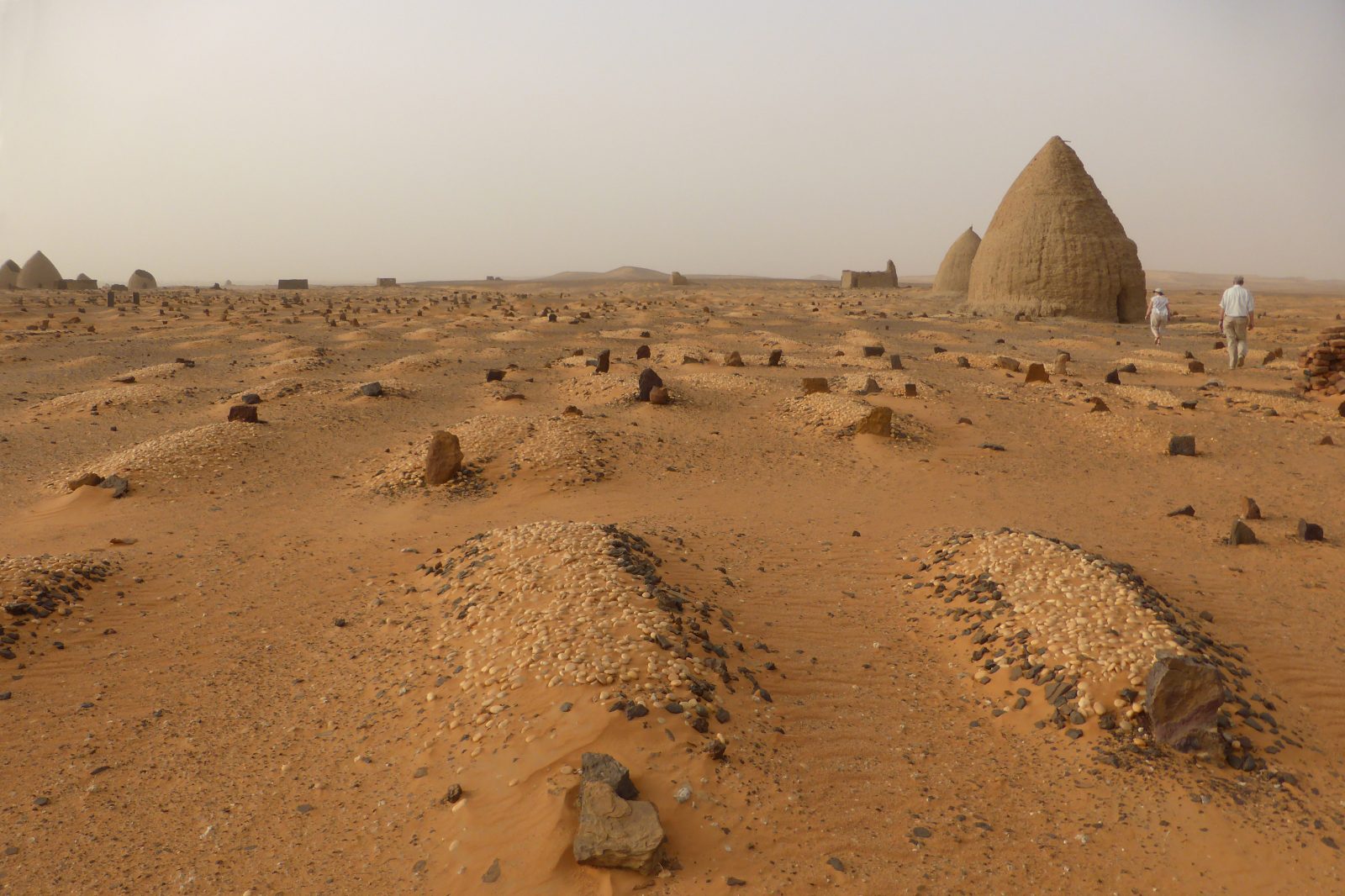
After Kush, the Nile valley in what is now Sudan was shared by three Christian Nubian kingdoms: Nobadia in the north, Makuria with its capital at Old Dongola, and Alodia with its capital at Soba, near modern Khartoum.[14]
Old Dongola was a large city. The archaeological site covers about 200 hectares, and besides the Great Church it had many other churches, at least two palaces and a large monastery on its north side.[11]
It was a city of several written languages. The odes on the church walls are in Greek; under the later kings, scribes wrote Arabic, while Nubian almost certainly stayed the language of daily life.[2][10]
Its closest parallel is Faras, the cathedral of the northern kingdom, famous for its paintings. When the church was first found in 2021, Obłuski said it gave “a great chance that there are more paintings and inscriptions under our feet, just like in Faras.”[7]
Excavation photographs
The 2026 photographs of the dig belong to PCMA UW and are not reproduced here. See them with their original credits:
Can you visit?
Old Dongola lies on the east bank of the Nile in Northern State, between the Third and Fourth Cataracts, and is on Sudan’s UNESCO Tentative List. The Great Church of Jesus is an active excavation, not an open visitor site. Check current travel advice before any trip.[15]
Quick answers
- Where is the Great Church of Jesus?
- In Old Dongola (Tungul), on the east bank of the Nile in Northern State, Sudan, the former capital of the Christian kingdom of Makuria.
- How big was the Great Church of Jesus?
- About 47 metres wide and 57 metres long, with an estimated height of 21 metres, according to the 2026 estimate.
- Who is excavating it?
- A joint expedition of the Polish Centre of Mediterranean Archaeology at the University of Warsaw and Sudan’s National Corporation for Antiquities and Museums, directed by Prof. Artur Obłuski.
- What was discovered in 2026?
- A monumental staircase, buttresses of the apse, the original floor, and a second painted church with Greek biblical odes, including the Prayer of Hannah.
- Who was King Qashqash?
- A ruler of Dongola in the late 16th or early 17th century, long thought semi-legendary, whose existence was confirmed by an Arabic order published in 2026.
Sources
- PCMA UW — Polish Centre of Mediterranean Archaeology, University of Warsaw
- HeritageDaily — Monumental medieval cathedral uncovered at Old Dongola (8 Nov 2026)
- Archaeology News Online — Archaeologists reach the original floor of Nubia’s largest cathedral (4 Nov 2026)
- Archaeology (AIA) — Original floor of Nubia’s largest medieval cathedral (9 Nov 2026)
- Earth.com — A massive buried church in Old Dongola (Nov 2026)
- Science in Poland — Archaeologists discover “unique” paintings in Old Dongola (2023)
- University of Warsaw — Discovery of the remains of the largest church in Old Dongola (2021)
- Barański, Obłuski & Wyżgoł — “The King of Nubia at work”, Azania: Archaeological Research in Africa (2026)
- Medievalists.net — Newly discovered document confirms a “legendary” African king (9 Mar 2026)
- Archaeology Wiki — A discovery from Old Dongola (6 Mar 2026)
- Wikipedia — Old Dongola
- Wikipedia — Dongola
- UNESCO — Archaeological Sites of the Island of Meroe
- Encyclopaedia Britannica — Sudan: History
- UNESCO — Sudan: properties and Tentative List
- Science in Poland — Newly discovered church in Dongola could have been a cathedral (2021)